
Every Clinical Research Associate (CRA) has experienced it.
A monitoring visit is scheduled for a full day, but by the end of the visit there are still outstanding tasks, unresolved findings, documents waiting to be filed, source documents to verify, and follow-up actions that extend well beyond the visit itself.
Likewise, research sites often feel overwhelmed preparing for monitoring visits. Coordinators spend hours locating documents, printing records, updating delegation logs, filing regulatory documents, and responding to monitor requests instead of focusing on participants and study execution.
The question is no longer whether monitoring can be improved.
The question is: Why are we still relying on paper-based processes in a digital world?
The Hidden Cost of Paper-Based Monitoring
Many clinical research sites continue to manage studies using a combination of paper source documents, paper regulatory binders, spreadsheets, shared drives, and multiple disconnected systems.
This creates several operational challenges:
• Time spent locating essential documents
• Manual verification of training and delegation records
• Missing signatures or outdated document versions
• Delays in source document verification
• Inconsistent filing of regulatory documents
• Multiple follow-up emails after every monitoring visit
• Increased administrative workload for site staff
As studies become more complex, these inefficiencies compound, resulting in longer monitoring visits and additional work for both CRAs and site personnel.
Monitoring Time Should Focus on Quality—Not Paperwork
The primary goal of monitoring is to verify participant safety, data quality, and protocol compliance.
However, a significant portion of monitoring visits is often consumed by administrative activities such as:
• Reviewing paper regulatory binders
• Reconciling delegation logs
• Checking training documentation
• Verifying document versions
• Searching for source records
• Tracking unresolved action items
These tasks add value when performed accurately, but they become much more efficient when supported by digital systems.
Building a Monitor-Friendly Clinical Research Site
Modern research sites are increasingly adopting integrated digital platforms that centralize study operations, documentation, and quality management.
A monitor-friendly site enables CRAs to spend more time reviewing study quality and less time searching for information.
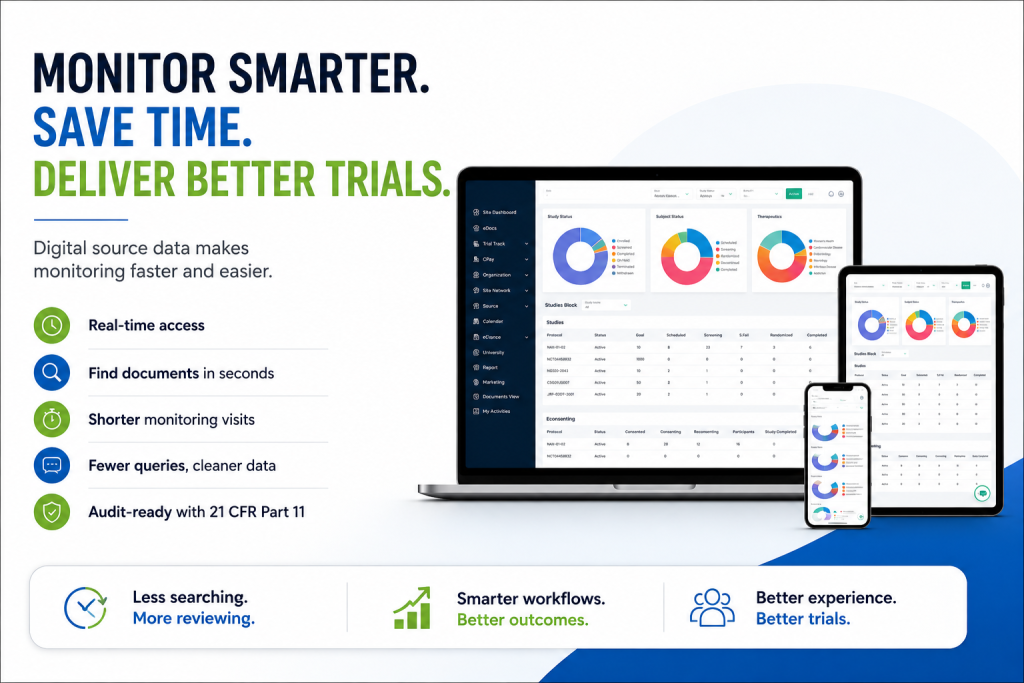
With an integrated platform like COSMOS CTMS, sites and monitors work from the same centralized source of information.
How COSMOS CTMS Improves Monitoring Efficiency
Automatically Generated Study Logs
Maintaining study logs manually can be time-consuming and prone to inconsistencies.
COSMOS automatically generates and maintains key operational logs, including:
• Delegation of Authority Log
• Training Logs
• Subject Screening & Enrollment Logs
• Investigator Signature Logs
• eConsent Logs
• Protocol Deviation Logs
• Site Visit Logs
• Investigational Product Logs
• Equipment Calibration Logs
This reduces manual administrative work while helping ensure logs remain current throughout the study.
Digital eSource Improves Source Verification
Electronic source documentation allows monitors to review participant data more efficiently.
Rather than navigating paper charts, eSource provides:
• Structured electronic documentation
• Complete audit trails
• Date and time stamps
• Version history
• Easier navigation between visits
• Support for remote monitoring when appropriate and permitted
This enables CRAs to focus on data review instead of document retrieval.
Built-In Quality Control Before Monitoring
One of the biggest advantages of digital workflows is identifying issues before a monitoring visit begins.
COSMOS includes integrated Quality Control (QC) workflows that help sites review study documentation before monitor review.
Potential issues can be identified earlier, reducing the number of findings during monitoring and improving documentation consistency.
Centralized Monitoring Queries
Managing monitoring findings through email often leads to fragmented communication.
COSMOS provides a centralized query management system where monitors can:
• Create monitoring findings
• Assign issues
• Track responses
• Monitor resolution status
• Maintain a complete history of actions
Everyone involved has visibility into outstanding items, making follow-up more efficient and transparent.
A Digital Regulatory Binder
Instead of searching through paper binders, monitors can quickly locate:
• Essential documents
• Investigator credentials
• Licenses
• CVs
• Financial disclosures
• SOP acknowledgements
• Training records
• IRB correspondence
• Version-controlled documents
This simplifies document review and supports consistent document management.
Better Collaboration Between Sites and Monitors
Digital platforms are not intended to replace the monitor they enable the monitor to spend more time on activities that matter most.
By reducing manual administrative work, both CRAs and site teams can focus on:
• Data quality
• Participant safety
• Protocol compliance
• Risk identification
• Timely issue resolution
Preparing for Today’s Regulatory Expectations
Modern guidance, including ICH GCP E6(R3), places greater emphasis on quality management, risk-based oversight, and reliable data throughout the clinical trial lifecycle.
Digital systems can support these objectives by improving documentation consistency, maintaining audit trails, and providing greater operational visibility. Features such as FDA 21 CFR Part 11-compliant electronic records and signatures, role-based access, and workflows aligned with ALCOA+ principles help sites maintain high standards of data integrity and inspection readiness.
The Future of Monitoring Is Digital
Monitoring visits should not be consumed by paperwork.
When research sites adopt integrated digital solutions such as COSMOS CTMS, COSMOS eSource, and COSMOS eDocs, they can reduce administrative burden, improve collaboration with monitors, and create more efficient workflows throughout the study lifecycle.
Digital transformation is not simply about replacing paper.
It is about giving coordinators, investigators, sponsors, and monitors the tools they need to work together more effectively, improve study quality, and spend more time on what matters most—delivering successful clinical trials.
Book your demo today