Enrollment Delays Don’t Start with Recruitment They Start with Limited Visibility
For many Sponsors and CROs, enrollment delays are often viewed as a recruitment problem.
But in many studies, the real issue starts much earlier: limited visibility into what is actually happening at the site level.
A study may have an enrollment target, a recruitment forecast, and a detailed study plan. Yet if Sponsors and CROs cannot see screening activity, enrollment conversion, site performance, and emerging recruitment risks in a timely manner, even the best recruitment strategy can quickly become outdated.
By the time a missed milestone appears in a weekly report, the underlying issue may have been developing for weeks.
The Enrollment Visibility Gap
Clinical trial enrollment generates a continuous stream of operational data.
Patients are identified and pre-screened. Screening visits take place. Eligibility criteria are assessed. Participants are enrolled, screen failed, withdrawn, or lost to follow-up. Sites adjust recruitment strategies based on their local patient population.
Yet much of this information is still communicated through fragmented workflows.
Study teams may rely on:
• Manual emails from sites
• Excel spreadsheets and trackers
• Weekly enrollment reports
• Phone calls and follow-up meetings
• Manually updated recruitment forecasts
• Separate systems for site and sponsor activities
These approaches can provide information, but they often don’t provide timely operational intelligence.
The result is a growing gap between what is happening at the site and what the study team can actually see.
What Sponsors and CROs Need to See
Enrollment performance is more than a single number showing how many participants have been enrolled.
To understand whether a study is on track, teams need visibility into the entire enrollment funnel.
For example:
Patients identified → Pre-screened → Screened → Screen failed → Enrolled → Retained
Each stage provides important information.
A site may appear to be performing well because it has screened a high number of patients. But if its screen-failure rate is unusually high, actual enrollment may remain below expectations.
Another site may have fewer screenings but a much stronger screening-to-enrollment conversion rate.
Without visibility into these underlying metrics, comparing sites based solely on enrollment numbers can lead to the wrong operational decisions.
Static Forecasts Can’t Keep Up with Dynamic Enrollment
Enrollment forecasts are typically created using assumptions about:
• Patient availability
• Site activation timelines
• Expected recruitment rates
• Screening-to-enrollment ratios
• Geographic reach
• Historical site performance
But study conditions change continuously.
A site may activate later than expected. Patient referrals may decline. Screening failures may increase. A competing study may affect recruitment. A site may have strong patient volume but insufficient recruitment resources.
When these changes are captured only in periodic reports, forecasts can quickly become outdated.
This creates a reactive cycle:
Enrollment slows → delay becomes visible → team investigates → corrective action begins.
By then, valuable time may already have been lost.
What If Study Teams Could See the Risk Earlier?
Imagine a study team could see, in near real time:
• Which sites are actively pre-screening patients
• Which sites have screening activity but low enrollment conversion
• Where screen failures are increasing
• Which sites are consistently below projected enrollment
• Which sites are trending toward missing recruitment milestones
• Where additional recruitment support may be needed
• How actual enrollment compares with the original forecast
The conversation changes.
Instead of asking:
“How is enrollment going?”
The team can ask:
“Which sites are creating enrollment risk, why is the risk developing, and what action should we take?”
That is the difference between reporting enrollment and managing enrollment.
From Enrollment Reporting to Enrollment Intelligence
This is where connected clinical operations can make a meaningful difference.
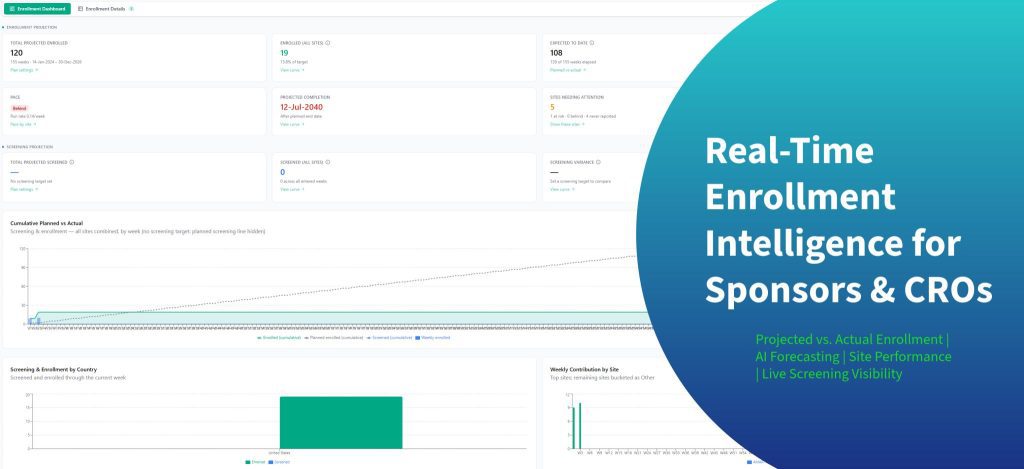
COSMOS TrialOps connects Sponsors, CROs, and research sites through a unified digital environment designed to provide greater visibility across study operations.
Instead of relying solely on periodic updates, study teams can use centralized, continuously updated study data to understand enrollment performance across sites.
With connected enrollment intelligence, teams can:
✔ Track screening and enrollment activity across sites
✔ Compare projected enrollment with actual performance
✔ Monitor screening failures and enrollment conversion
✔ Identify underperforming and at-risk sites
✔ Detect emerging enrollment trends earlier
✔ Support AI-driven enrollment forecasting using available study data
✔ Prioritize sites that require recruitment intervention
✔ Improve communication between Sponsors, CROs, and Sites
✔ Make operational decisions based on current study intelligence
The objective isn’t simply to collect more data.
The objective is to turn study data into actionable insight.
Give Study Teams the Ability to Act Before a Milestone Is Missed
Consider two scenarios.
Scenario 1: Reactive Management
A site submits its weekly report showing that enrollment is below target.
The study team reviews the data, schedules a call, investigates recruitment challenges, develops a corrective action plan, and waits for the next reporting cycle to determine whether performance improves.
Scenario 2: Connected Management
The study dashboard shows that a site’s screening volume has declined, its conversion rate is trending downward, and projected enrollment is moving below target.
The study team identifies the risk earlier, engages the site, and provides targeted recruitment support before the enrollment milestone is missed.
The difference is not necessarily more recruitment resources.
It is better visibility and faster intervention.
Better Visibility Creates Better Forecasting
Accurate forecasting depends on accurate and timely information.
When enrollment forecasts incorporate current screening activity, enrollment rates, conversion trends, and site-level performance, study teams can make more informed projections.
Over time, this can help answer critical questions:
Are we still on track to meet the enrollment target?
Which sites are most likely to meet their recruitment commitments?
Which sites require intervention?
Is the issue patient availability, screening conversion, or site execution?
Where should recruitment resources be allocated?
Do current enrollment trends support the original study timeline?
These are operational questions that cannot always be answered effectively through a static spreadsheet or weekly report.
The Future of Enrollment Management Is Connected
Clinical trial enrollment will always depend on patients, investigators, site capabilities, and effective recruitment strategies.
Technology cannot eliminate those fundamentals.
But technology can help study teams see what is happening sooner, understand why it is happening, and respond faster.
That is the opportunity with connected clinical operations.
When Sponsors, CROs, and Sites work from fragmented information, enrollment management becomes reactive.
When they work from connected, actionable intelligence, teams gain greater control over study execution.
Enrollment delays don’t always start with a lack of patients.
Sometimes, they start with not seeing the problem soon enough.
The future of clinical trial enrollment isn’t about collecting more reports.
It’s about turning live study data into timely decisions.
Real-time visibility leads to better decisions.
Better decisions lead to faster intervention.
Faster intervention can help keep clinical trials moving forward.