
Clinical research has never had more technology.
CTMS platforms, eTMFs, investigator portals, LMS, payment systems, eConsent, document repositories, spreadsheets, email, and collaboration tools are now part of almost every clinical trial.
Yet many Sponsor and CRO teams continue to experience the same operational challenges.
The issue isn’t a lack of software.
It’s that critical study activities are often spread across disconnected systems.
When Systems Don’t Work Together
Every clinical trial generates thousands of operational tasks long before the first patient is enrolled.
Study startup teams identify and qualify sites.
Regulatory teams collect and review essential documents.
Clinical operations coordinate site readiness.
Training teams ensure investigators complete protocol-specific education.
Finance teams negotiate budgets and manage site payments.
Safety teams distribute notifications and track acknowledgements.
When each activity is managed in a separate application, teams spend more time coordinating information than progressing the study.
The result is often:
- Duplicate data entry
- Multiple logins across different systems
- Manual follow-up emails
- Limited operational visibility
- Delayed study startup
- Increased compliance risk
Technology should reduce complexity not create it.
The Cost of Fragmented Clinical Operations
Disconnected systems create challenges that affect every stakeholder involved in a study.
Sponsors
Sponsors often struggle to obtain a single, real-time view of study progress because information is distributed across multiple vendors and platforms.
CROs
Project managers spend valuable time consolidating reports, tracking outstanding activities, and coordinating communication instead of focusing on study execution.
Clinical Sites
Sites frequently manage different sponsor portals, regulatory systems, training platforms, and communication channels simultaneously, increasing administrative burden.
When every stakeholder works in a different environment, collaboration becomes slower and more difficult.
What Modern Trial Operations Should Look Like
Instead of moving between disconnected applications, study teams benefit from having operational activities managed from a centralized platform.
An integrated operational approach allows organizations to:
- Coordinate study startup activities
- Manage investigator training and compliance
- Maintain centralized regulatory documentation
- Track site readiness and milestones
- Assign and monitor operational tasks
- Share study communications and newsletters
- Manage safety notifications and acknowledgements
- Support collaboration between Sponsors, CROs, Sites, Labs, and Vendors
- Maintain complete audit trails and 21 CFR Part 11 compliance
The objective isn’t simply to digitize processes.
It’s to create connected clinical operations.
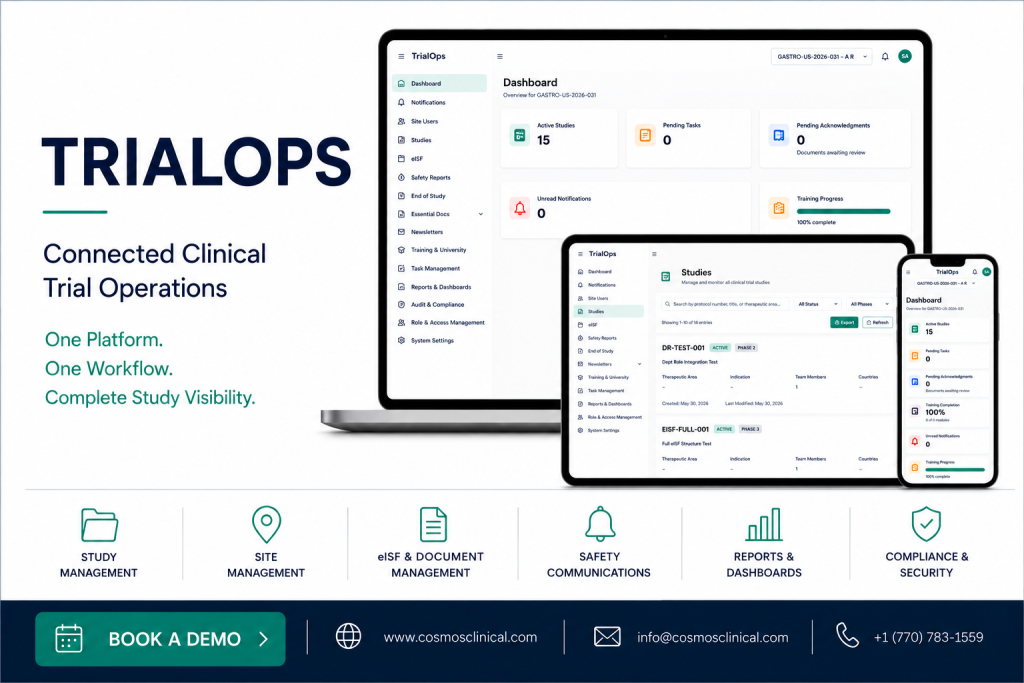
Introducing COSMOS TrialOps
COSMOS TrialOps is designed to bring essential clinical trial operational activities together into one connected environment.
Rather than relying on multiple independent systems, TrialOps enables organizations to manage study execution through a single operational workspace.
Key capabilities include:
- Study and site management
- Investigator training management
- Regulatory document management (eISF)
- Operational task management
- Site readiness tracking
- Safety communications
- Study newsletters
- Vendor and stakeholder collaboration
- Audit-ready documentation
- 21 CFR Part 11 compliant workflows
By connecting these operational processes, TrialOps helps reduce manual coordination while improving visibility across the entire study lifecycle.
Why Connected Operations Matter
Successful clinical trials depend on more than collecting quality data.
They depend on efficient collaboration, consistent execution, and operational visibility.
When teams no longer need to search across multiple systems for information, they can spend more time focusing on study delivery, patient enrollment, and quality.
Connected operations help organizations:
- Accelerate study startup
- Improve collaboration
- Reduce administrative effort
- Increase operational transparency
- Strengthen compliance readiness
- Improve overall study execution
Looking Ahead
As clinical trials become more decentralized and increasingly complex, operational efficiency becomes a competitive advantage.
Organizations that continue relying on disconnected systems may experience unnecessary delays and increased administrative workload.
Those adopting connected operational platforms can simplify workflows, improve collaboration, and create greater visibility across every phase of the clinical trial.
Clinical trials don’t need more software.
They need software that works together.
Ready to simplify your clinical trial operations?
Discover how COSMOS TrialOps helps Sponsors, CROs, and research sites manage clinical trial operations through one connected platform.
Book a personalized demo today and explore how TrialOps can support your next study.https://www.cosmosclinical.com/live-demo/