

As clinical research transitions from paper-based methods to digital-first operations, eSource (electronic source data capture) has emerged as a key driver of efficiency, compliance, and data quality. Yet, for many research sites, justifying the investment in eSource technology requires one essential question to be answered:
What is the return on investment (ROI) of eSource, and how can it be measured practically?
This article outlines a clear, actionable framework for measuring eSource ROI, aligned with ICH GCP E6(R3) guidance, and demonstrates how tools like COSMOS CTMS empower sites to realize and quantify those benefits.
What Is eSource in Clinical Trials?
- Subject visits
- Clinical assessments
- Patient-reported outcomes
- Vital signs and lab data
- Investigator notes
Why Measuring eSource ROI Matters
- Justify the investment to stakeholders and sponsors
- Benchmark performance improvements
- Optimize workflows and resource allocation
- Align with regulatory expectations (e.g., ICH GCP R3, FDA Part 11)
The ROI Formula for eSource
To evaluate eSource ROI, research sites should calculate:
ROI (%) = [(Total Benefits – Total Costs) / Total Costs] × 100
This framework breaks down into measurable categories:
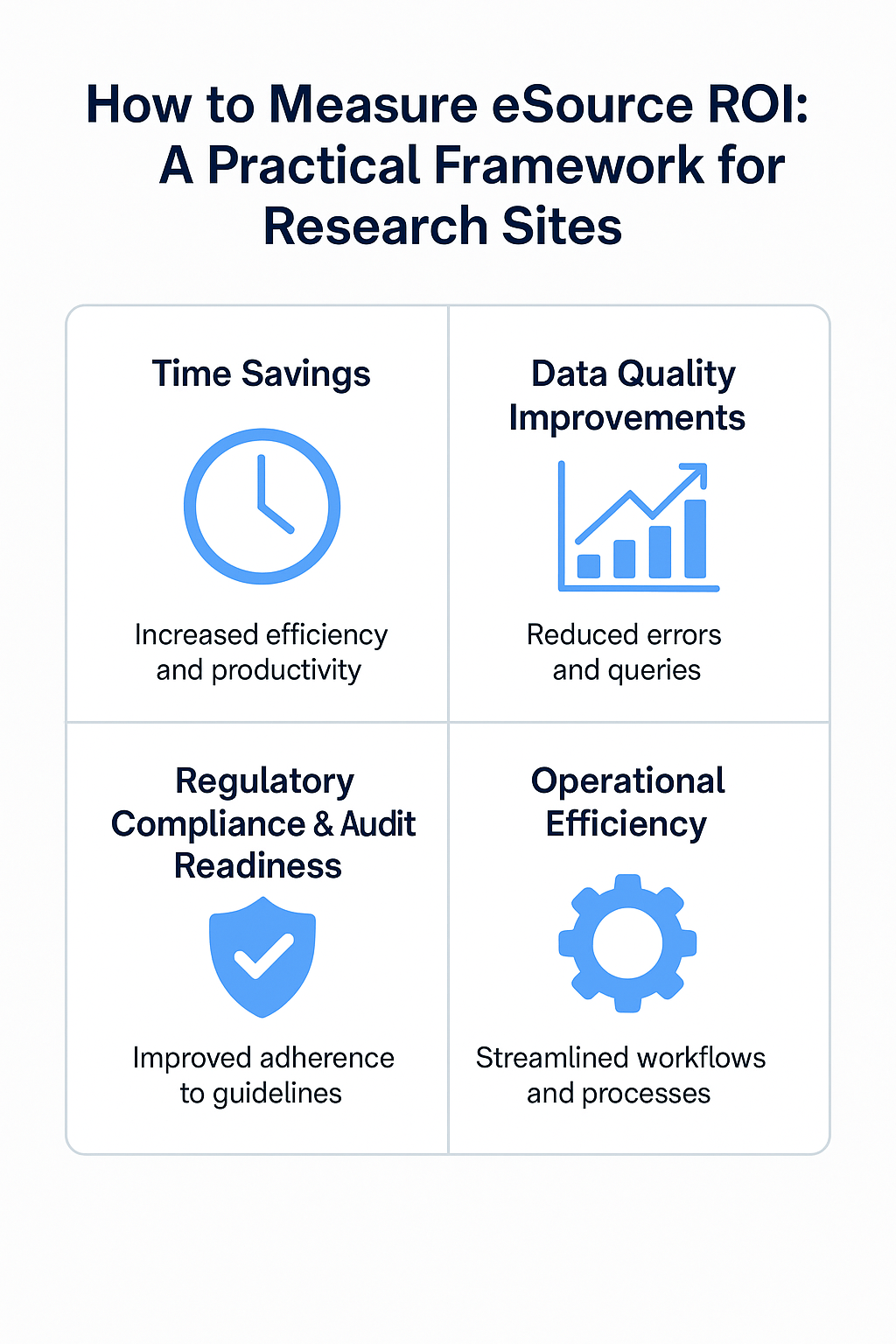
✅ 1. Time Savings
2Pre-eSource: Manual transcription from paper to EDC could take 15–30 minutes per visit.
With eSource: Data is entered once, validated, and ready for review in real-time.
Example ROI Metric:
- Average time saved per visit × Number of visits × Staff hourly rate
- Reduced time in query resolution and data cleaning
✅ 2. Data Quality Improvements
- Fewer data queries × Time to resolve per query × Staff hourly rate
- Cost of repeat patient visits or missed data points avoided
✅ 3. Regulatory Compliance & Audit Readiness
Pre-eSource: Manual logs, incomplete audit trails, and version control issues.
With eSource: Automatic time-stamps, audit trails, and secure access comply with ICH GCP R3 and 21 CFR Part 11.
Example ROI Metric:
- Reduced time spent preparing for audits
- Decreased risk of inspection findings or data discrepancies
✅ 4. Operational Efficiency
- Faster startup timelines
- Improved visit documentation completion rates
- Increase in concurrent studies managed per coordinator
How COSMOS CTMS Helps You Measure and Maximize ROI
- Go fully paperless
- Ensure compliance with ICH GCP R3
- Capture metrics to calculate real-time ROI
- Automate operational tasks that reduce site burden
🔍 COSMOS ROI-Enhancing Features:
| Feature | ROI Benefit |
| eSource with logic rules | Reduces data entry time and errors |
| Visit and deviation logs | Automates documentation and compliance |
| Real-time dashboards | Provides performance metrics across studies |
| Training tracker | Ensures GCP and protocol compliance |
| COSMOS Pay | Automates subject reimbursements and reduces administrative time |
Real-World Example
- Time saved per visit: 20 minutes × 600 visits = 200 hours
- Data queries reduced: 300 fewer queries × $25 per query resolution = $7,500 saved
- Audit prep time reduced: From 20 hours to 6 hours per study
- Increased study throughput: 25% more studies managed without additional staff
Final Thoughts
Measuring the ROI of eSource isn’t just about cost savings—it’s about smarter operations, better compliance, and long-term site sustainability. With ICH GCP E6(R3) setting new expectations for digital transformation and data quality, now is the time for research sites to adopt structured, measurable digital solutions.
COSMOS CTMS offers the tools and insights research sites need to digitize, track, and maximize ROI across every study phase.
Ready to Start Measuring Your ROI?
Schedule a demo of COSMOS today and discover how your site can streamline workflows, ensure compliance, and quantify the full value of eSource adoption.