
Clyra eConsent
eConsent is a secure digital informed consent solution that improves patient understanding, compliance, and study efficiency. Enable remote consenting, multimedia engagement, real-time tracking, and 21 CFR Part 11 compliant electronic signatures for decentralized and hybrid clinical trials.

eConsent Software for Secure, Patient-Centric Clinical Trial Participation
A Smarter, Patient-Centric Consent Experience
ECONSENT transforms the informed consent process by delivering a secure, digital, and patient-friendly experience. It enables research teams to present study information in a clear, interactive format, helping participants better understand the trial before providing consent.
Traditional paper-based consent processes can be time-consuming and difficult for participants to review thoroughly. eConsent simplifies this workflow by allowing participants to review consent materials remotely, at their own pace, with improved clarity, accessibility, and engagement.
By improving participant understanding, eConsent supports ethical research practices and strengthens the quality of informed consent documentation.
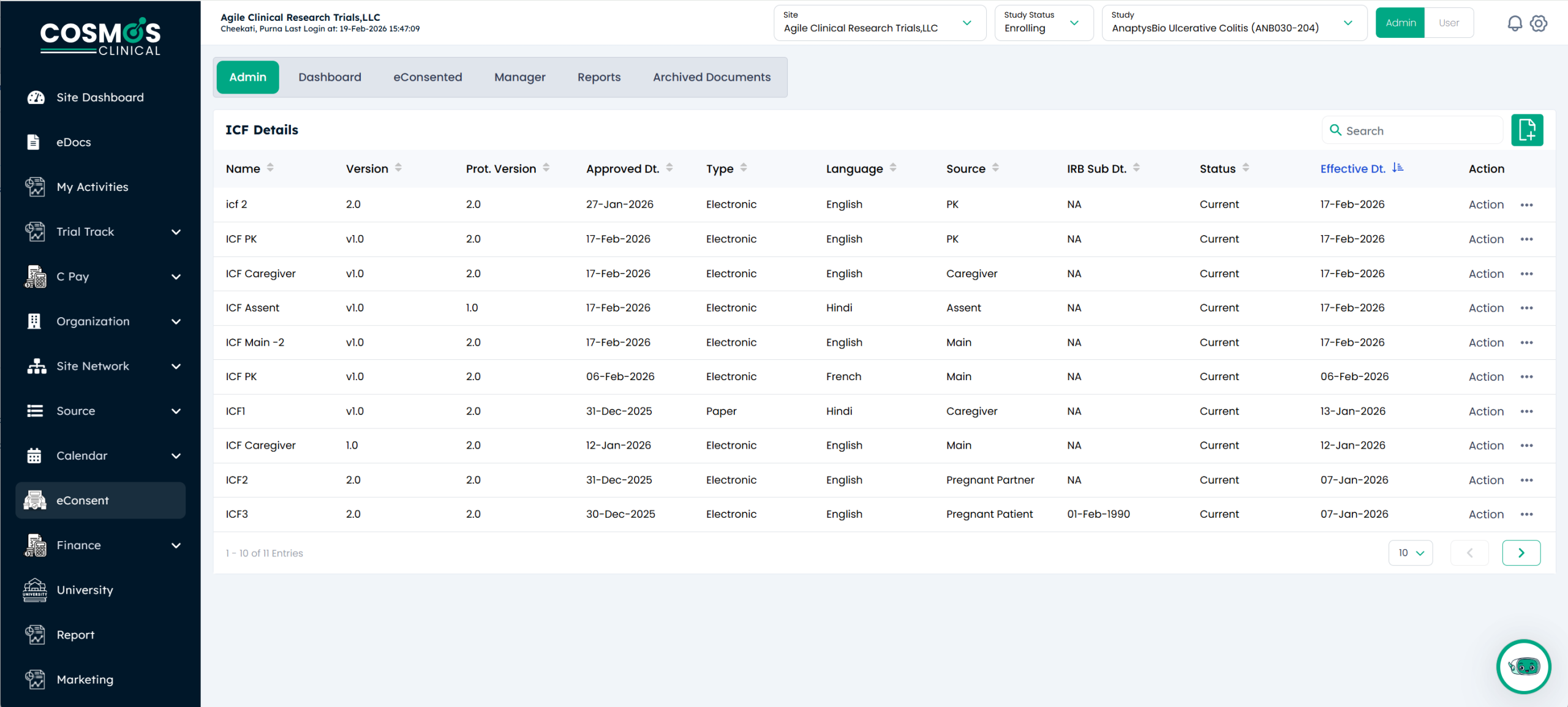
Improve Participant Understanding Through Interactive Multimedia Content
eConsent enhances participant engagement by supporting multimedia elements that improve comprehension of study procedures, risks, and expectations.
The platform supports:
- Video explanations of study procedures
- Visual illustrations and guided content
- Interactive consent sections
- Step-by-step consent review process
- Patient-friendly digital presentation of information
- Remote review capability for decentralized trials
Multimedia-supported consent improves participant confidence, increases engagement, and helps ensure that participants make informed decisions about trial participation.
Enable Remote Consent for Decentralized and Hybrid Clinical Trials
eConsent supports decentralized clinical trial models by enabling participants to review and sign consent documents remotely. Participants can access consent materials securely from their preferred location, reducing the need for in-person visits while maintaining regulatory compliance.
Remote consent capabilities help:
- Improve participant convenience
- Accelerate study enrollment timelines
- Support hybrid and decentralized trial models
- Expand access to geographically diverse participants
- Improve participant retention and engagement
Digital consent workflows support modern clinical trial operations while maintaining participant safety and transparency.
21 CFR Part 11 Compliant Electronic Signature and Audit Trail
eConsent supports electronic signature workflows aligned with 21 CFR Part 11 regulatory requirements, ensuring that consent documentation is secure, traceable, and audit-ready.
Compliance features include:
- Electronic signature capture compliant with 21 CFR Part 11
- Complete audit trail documentation
- Consent version control and tracking
- Time-stamped signature records
- Secure storage of consent documents
- Controlled access permissions
- Data integrity aligned with ALCOA-C principles
These capabilities help organizations maintain regulatory compliance and inspection readiness.
Centralized Consent Document Management
eConsent provides a centralized system for managing consent documentation throughout the clinical trial lifecycle. Study teams can securely store, retrieve, and track consent records in one platform.
Document management capabilities include:
- Centralized consent document repository
- Version control for updated consent forms
- Automated document tracking
- Easy retrieval of signed consent records
- Secure digital storage
- Inspection-ready documentation
Centralized documentation improves operational efficiency and reduces risk of missing or incomplete consent records.
Real-Time Tracking and Visibility into Consent Progress
eConsent provides real-time visibility into consent status across participants and study sites. Study teams can monitor progress and identify delays quickly, improving enrollment efficiency and operational oversight.
Tracking features include:
- Real-time consent status monitoring
- Participant progress tracking dashboards
- Notifications for pending consent completion
- Visibility into consent milestones
- Study-level consent reporting
Real-time insights help research teams reduce delays and maintain consistent study timelines.
Improve Operational Efficiency While Enhancing Patient Experience
By digitizing and standardizing consent workflows, eConsent improves both operational efficiency and participant experience.
Key benefits include:
- Reduced paper-based documentation burden
- Improved participant understanding of study procedures
- Faster consent completion timelines
- Improved enrollment efficiency
- Enhanced regulatory compliance
- Reduced risk of documentation errors
- Increased transparency across stakeholders
- Support for remote and decentralized trials
eConsent ensures that informed consent is delivered in a modern, accessible, and compliant format aligned with evolving clinical research needs.
Designed for Modern Clinical Trial Environments
eConsent supports sponsors, CROs, and research sites seeking to modernize participant engagement while maintaining full regulatory compliance.
The platform enables organizations to:
- Improve informed consent quality
- Enhance participant understanding and trust
- Maintain audit-ready documentation
- Support decentralized and hybrid clinical trial models
- Improve operational efficiency
- Ensure regulatory compliance with 21 CFR Part 11
- Maintain complete visibility into consent workflows
Below is an SEO-optimized comparison webpage for Paper Consent vs eConsent, designed to support patient-centric clinical trials, ICH-GCP compliance, ALCOA-C data integrity, and 21 CFR Part 11 electronic signature requirements.
Paper Consent vs eConsent in Clinical Trials
Paper Consent vs eConsent: Modernizing the Informed Consent Process
Why Clinical Trials Are Moving from Paper Consent to eConsent
The informed consent process is one of the most critical ethical and regulatory requirements in clinical trials. Traditionally, consent has been obtained using paper documents, which can be time-consuming, difficult to manage, and prone to operational inefficiencies.
eConsent modernizes this process by digitizing the informed consent workflow, improving participant understanding, enhancing compliance, and increasing operational efficiency.
Sponsors, CROs, and research sites are increasingly adopting electronic informed consent (eConsent) solutions to support decentralized trials, improve participant engagement, and maintain audit-ready documentation aligned with regulatory expectations.
Paper Consent vs eConsent Comparison
Feature | Paper Consent | eConsent |
Participant Understanding | Limited ability to include visual aids or guided explanations | Multimedia content such as videos, visuals, and guided instructions improve comprehension |
Accessibility | Requires in-person visit | Remote access from any location |
Participant Experience | Static document review | Interactive and patient-friendly experience |
Enrollment Speed | Slower due to manual scheduling and document handling | Faster enrollment with remote review and electronic signature |
Document Management | Physical storage and manual filing | Centralized digital document management |
Version Control | Risk of outdated forms being used | Automatic version control and tracking |
Compliance Tracking | Manual tracking required | Automated audit trail and tracking |
21 CFR Part 11 Compliance | Requires additional documentation processes | Built-in Part 11 compliant electronic signature workflows |
Audit Readiness | Requires manual document preparation | Audit-ready digital records with traceability |
Data Integrity (ALCOA-C) | Risk of missing or incomplete records | Ensures attributable, legible, contemporaneous, original, and accurate documentation |
Decentralized Trial Support | Limited | Fully supports hybrid and decentralized trials |
Consent Status Visibility | Limited tracking visibility | Real-time dashboards and tracking |
Operational Efficiency | Requires manual coordination | Automated workflows reduce administrative burden |
Storage & Retrieval | Physical storage required | Instant retrieval of digital records |
Risk of Errors | Higher risk of missing signatures or incomplete fields | Automated validation reduces human error |
Participant Retention | Limited engagement tools | Improved understanding supports better retention |
Regulatory Inspection Preparation | Time-consuming manual preparation | Inspection-ready documentation available instantly |
Key Limitations of Traditional Paper Consent
Paper-based informed consent processes present several operational challenges:
- Limited participant understanding due to static text-only format
- Difficult document tracking and version management
- Risk of incomplete or missing signatures
- Increased administrative workload for site teams
- Manual storage and retrieval processes
- Limited visibility into consent status
- Increased risk of compliance findings during audits
- Challenges supporting decentralized clinical trials
- Delays in study enrollment timelines
Paper workflows often require additional manual verification to ensure completeness and regulatory compliance.
Advantages of eConsent in Modern Clinical Trials
eConsent improves both participant experience and study operations by providing a digital, interactive, and compliant consent workflow.
Key advantages include:
- Improved participant understanding through multimedia content
- Remote consent capability for decentralized trials
- Automated version control and document tracking
- Real-time consent status visibility
- Secure electronic signature compliant with 21 CFR Part 11
- Reduced manual documentation workload
- Improved audit readiness
- Enhanced compliance with ICH-GCP requirements
- Centralized document storage and retrieval
- Improved participant engagement and trust
eConsent helps research teams ensure that participants fully understand study requirements before providing consent.
Support Decentralized and Hybrid Clinical Trials
As clinical trials increasingly adopt decentralized and hybrid models, digital consent solutions are essential for enabling remote participation.
eConsent allows participants to review study information at their own pace and sign securely from their preferred location, improving convenience and expanding access to clinical research.
Remote consenting capabilities help:
- Improve participant recruitment
- Expand geographic reach
- Reduce site visit burden
- Accelerate enrollment timelines
Improve participant satisfaction
Enhance Compliance with 21 CFR Part 11 and ICH-GCP
eConsent supports regulatory compliance by providing secure electronic signatures, complete audit trails, and controlled document workflows aligned with industry regulations.
Compliance features include:
- 21 CFR Part 11 compliant electronic signatures
- Time-stamped consent documentation
- Complete audit trail tracking
- Secure storage of consent records
- Version control for updated consent forms
- Data integrity aligned with ALCOA-C principles
- Inspection-ready documentation
Digital compliance workflows help reduce regulatory risk and improve inspection readiness.
Why Sponsors, CROs, and Sites Prefer eConsent
Organizations are increasingly adopting eConsent solutions because they improve both operational efficiency and participant experience.
Benefits include:
- Faster enrollment timelines
- Reduced administrative burden
- Improved participant understanding
- Increased transparency across stakeholders
- Improved regulatory compliance
- Reduced risk of documentation errors
- Improved inspection readiness
- Scalable workflow management
Support for modern decentralized trials
Real-Time Tracking and Visibility into Consent Progress
eConsent provides real-time visibility into consent status across participants and study sites. Study teams can monitor progress and identify delays quickly, improving enrollment efficiency and operational oversight.
Tracking features include:
- Real-time consent status monitoring
- Participant progress tracking dashboards
- Notifications for pending consent completion
- Visibility into consent milestones
- Study-level consent reporting
Real-time insights help research teams reduce delays and maintain consistent study timelines.